

This is Part 4 of the West Bengal Data Series. Part 1 looked at Kolkata versus India’s other megacities. Part 2 examined West Bengal’s investment and industrial structure. Part 3 looked at health outcomes.
If this series has been useful, subscribe below.
Ask anyone from West Bengal about the state’s “intellectual heritage”, and they will not stop talking. Tagore. Ray. Sen. Banerjee. Two Nobel laureates in economics. One in literature, also the first Asian. A filmmaker who put Bengal on the world map. A city that ran the country for 138 years.
The data has a more complicated view.
The literacy number
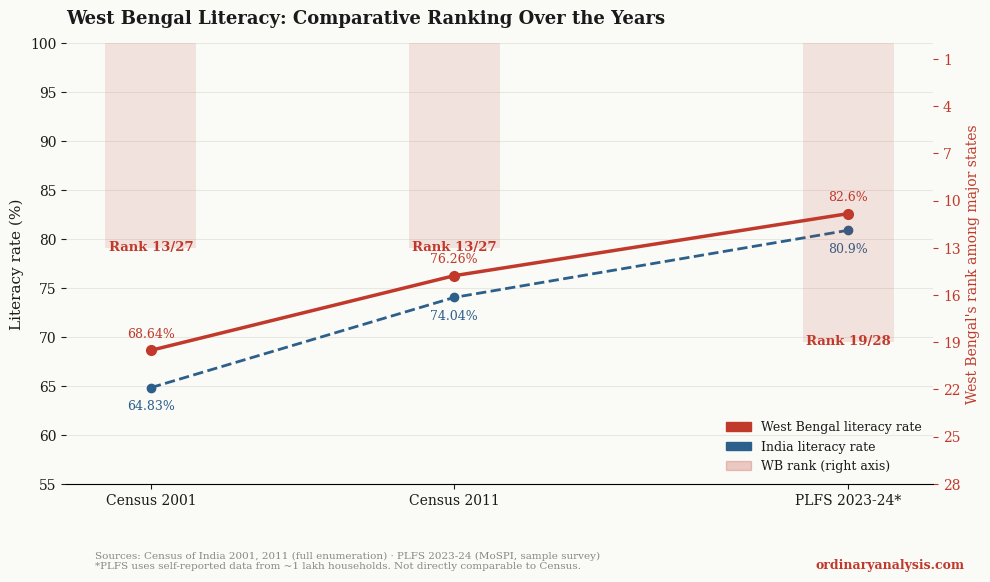
West Bengal’s literacy rate in 2011 was 76.26%. The national average that year was 74.04%. Bengal was ahead and ranked 13th out of 27 states.
Not first or second. Or third. But Thirteenth.
Between 2001 and 2011, that rank did not move. India improved. West Bengal improved at roughly the same pace. No ground gained, no ground lost.1
The gender picture
This is the part of the data that is genuinely positive.
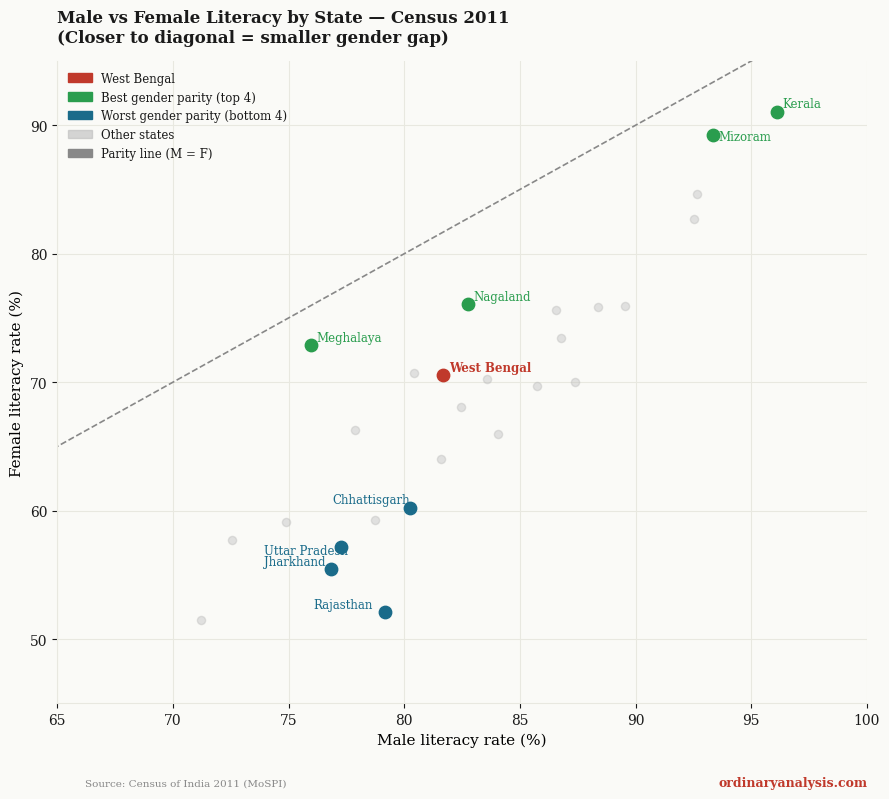
In 2011, the gap between male and female literacy in West Bengal was 11 percentage points. Among 27 major states, West Bengal was placed 9th best on gender parity. Better than Gujarat, Karnataka, Odisha, and most of the Hindi belt. The states with worse gaps included several that are conventionally considered more developed.
By PLFS 2023-24, that gap had narrowed to 6.5 points, placing West Bengal 7th best among 28 major states. The improvement is real, and it is faster than most peers.
On this one measure, West Bengal is in the better half of the country and moving in the right direction. One caveat worth keeping in mind: the improvement reflects a narrowing gap, not both genders becoming more literate. Women are closing in on men. That is a different and perhaps a more meaningful signal than the overall rise in literacy.
Where children fall off
West Bengal and Tamil Nadu are the only two states that maintain their own education MIS and submit bulk data to UDISE+2, rather than feeding directly into the national system. Their primary-level dropout figures, both reported as zero, should be read with that in mind.
The secondary level is a different story.
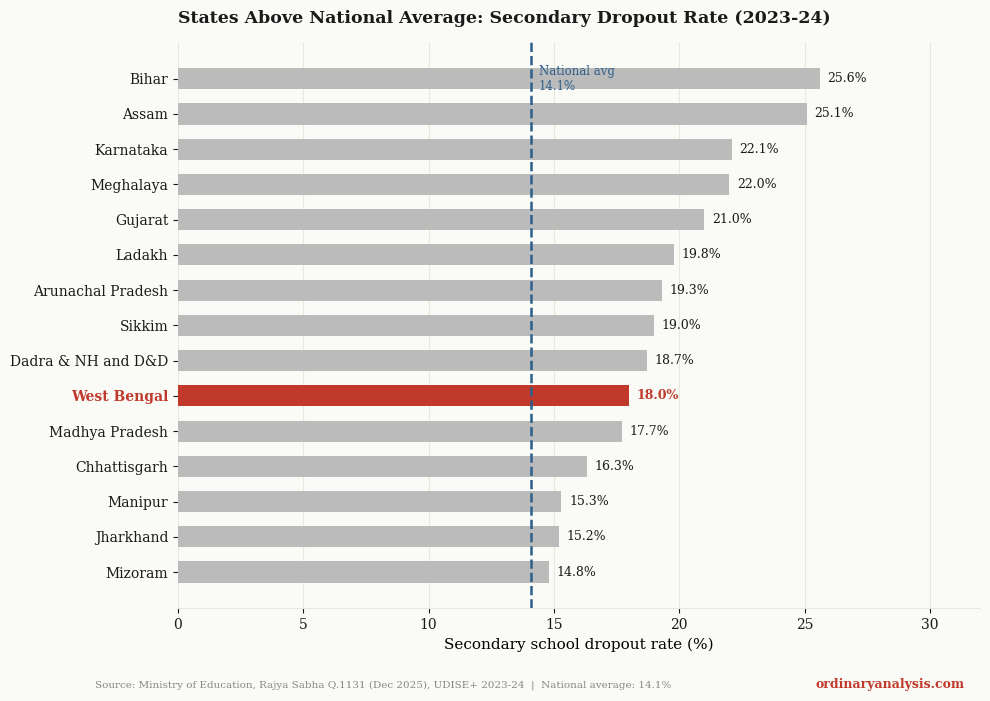
West Bengal’s secondary school dropout rate in 2023-24 was 17.98%. The national average is 14.1%. Among states above that average, West Bengal sits in the upper half, in the same band as Madhya Pradesh and Chhattisgarh (and surprisingly, Karnataka).3
The structural reason is visible in the school composition data. 79% of schools in West Bengal are at the foundational and preparatory level. Only 11.6% are secondary. Imagine a child who just completed Class 8 in a remote district, and the nearest secondary school is far, then the decision to continue doesn’t remain purely academic. It is logistical and economic. And that often means forcing an undue goodbye.
This is made more uncomfortable by the ghost school data. UDISE+ 2023-24 identified 3,254 schools in West Bengal with zero student enrolment, the highest count in the country. These schools collectively employed 14,627 teachers. Infrastructure and teaching capacity are concentrated where students are no longer located, while districts with growing adolescent populations lack access to secondary education. The state education minister’s response when this was reported: “I have to look into it.”4
Income and poverty
West Bengal has hovered around ₹75-82 for every ₹100 earned by the average Indian over the past decade, consistently below the national average. The gap has not closed.5
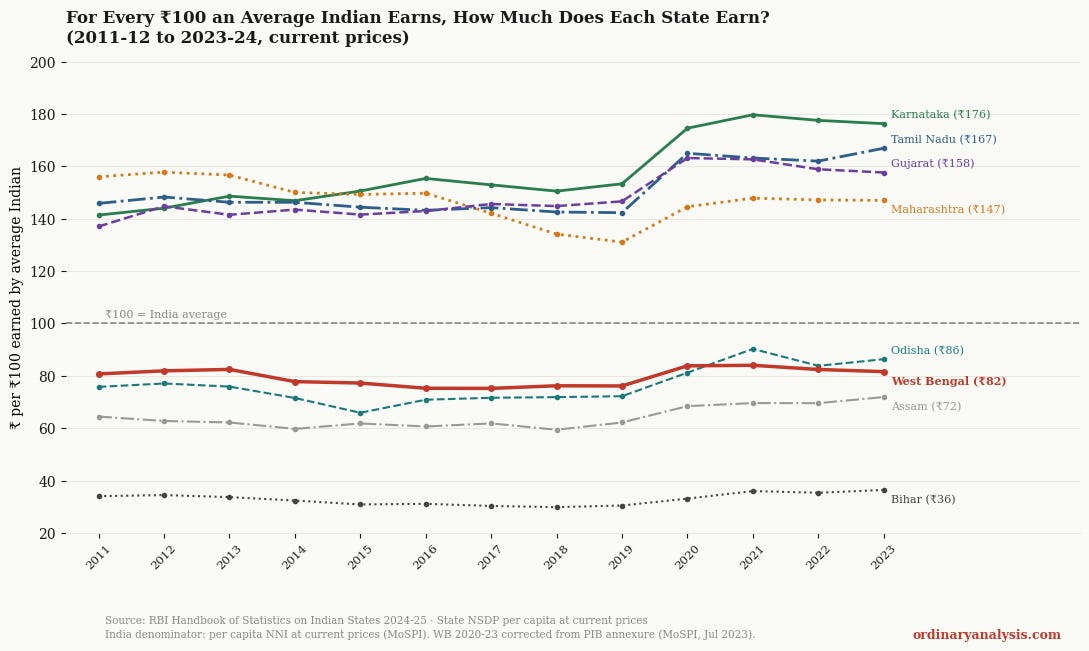
We need to take a pause and absorb what this chart is actually telling us. It does not measure absolute income. It measures how each state’s economy performs relative to the national average, on a per-person basis. If the average Indian earned ₹100 in 2023, West Bengal’s economy generated ₹82 per person, Karnataka’s ₹175, Bihar’s ₹36.
That framing matters. West Bengal is not getting poorer in absolute terms. It is failing to keep pace. And in a country where Karnataka and Tamil Nadu are pulling away, failing to keep pace is its own kind of falling behind.
This ties it back to part 2 of the series. When you have an ‘unproductive’ workforce. This is bound to happen.
The multidimensional poverty numbers tell a relatively encouraging story. West Bengal’s MPI poverty rate fell from 21.28% in 2015-16 to 11.89% in 2019-21, below the national average of 14.96%. Welfare delivery has worked. People have moved out of deprivation on the indicators that matter: sanitation, cooking fuel, electricity, and bank access. These are essential for a human being.
But almost every state improved by a comparable margin. West Bengal’s relative position did not change. The same states that were ahead in 2015-16 were ahead in 2019-21. Those who were behind are still pretty much behind. Welfare worked. It just worked everywhere. For everyone.
What the HDI says
The Human Development Index (HDI) tries to answer a simple question: how well are people actually living? It combines various factors that are important for a good life into a single number. India’s state-level HDI rankings place West Bengal at 0.674, ranked 20th among 28 major states, below the national average of 0.685.
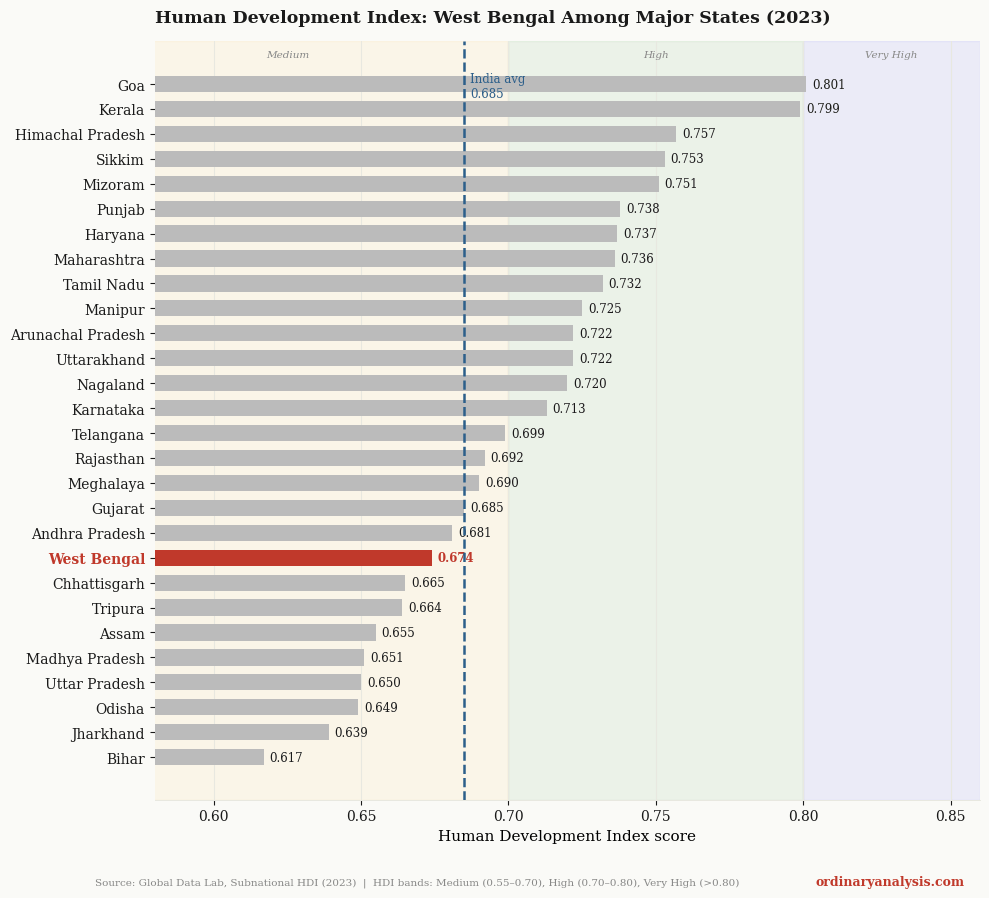
West Bengal scores above the national average on both the health component (life expectancy ~71-72 years) and the education component (mean years of schooling ~7.5). Which is not bad. But it is the per capita income that pulls the composite down (might be the same reason why Goa is number 1). Per capita GSDP sits well below the national average.
Amartya Sen and Abhijit Banerjee. The two economists who got their Nobel for measuring and understanding human development are both from West Bengal.6 The state that produced them has a human development index score that Kerala crossed decades ago. That sentence is uncomfortable to write. But it is accurate.
West Bengal delivers at the baseline. Literacy is above average. The gender gap is narrowing. Primary enrolment is high. Poverty is falling faster than in most states. These are real, and the data is quite clear on them.
But the next layer does not hold. Secondary dropout is among the worst in the country. Per capita income is not moving upwards against the national average. HDI has been stuck in the medium band for a long time. The state gets people through the door. It has not figured out what to do with them once they are inside.
Welfare worked. Wealth did not follow.
Data sources:
Census of India 2001, 2011 (Office of the Registrar General)
PLFS 2023-24 (MoSPI)
UDISE+ 2023-24 (Ministry of Education)
Rajya Sabha Q.1131, Dec 2025 (Ministry of Education)
NITI Aayog National MPI Progress Review 2023
RBI Handbook of Statistics on Indian States 2024-25
Global Data Lab Subnational HDI 2023
The 2001 and 2011 figures come from the Census of India, a full detailed data of every household, supposedly. The PLFS 2023-24 figure comes from a sample survey of approximately one lakh households and uses self-reported literacy. The two methodologies are not directly comparable. Rank changes post-2011, particularly for smaller northeastern states where sample sizes are limited, should be read with caution. The rank of 13th in both 2001 and 2011 is based on 27 major states.
UDISE+ Report 2023-24, Ministry of Education, Government of India (education.gov.in). The report states: "all States/UTs except Tamil Nadu and West Bengal are directly feeding data into UDISE+ portal."
Karnataka’s secondary dropout rate in 2023-24 was 22.1%, higher than West Bengal’s 17.98%. This made headlines in early 2025 as a surprising result for a relatively prosperous southern state. While doing the research for this part, I was also a bit surprised to see this figure. https://www.deccanherald.com/india/karnataka/at-222-school-dropout-rate-in-karnataka-much-above-natl-avg-3592712
The framing of per capita income as “₹ earned per ₹100 earned by the average Indian” draws from Data For India’s analysis of state economies (dataforindia.com). "The economies of Indian states" by Abhishek Waghmare, Data For India, November 2024 URL: https://www.dataforindia.com/state-economies/
Amartya Sen won the Nobel Memorial Prize in Economic Sciences in 1998 for his contributions to welfare economics and social choice theory. His capability approach is foundational to how the Human Development Index is constructed. Abhijit Banerjee won in 2019, alongside Esther Duflo and Michael Kremer, for his experimental approach to alleviating global poverty.