

It was almost 17:30. A chilly overcast day. Our train just reached Liverpool. The Liverpool Lime Station particularly. Outside of the Liverpool Lime Street station, there’s a poster. It reads: “Open, Proud & Welcoming.” You can’t miss it.
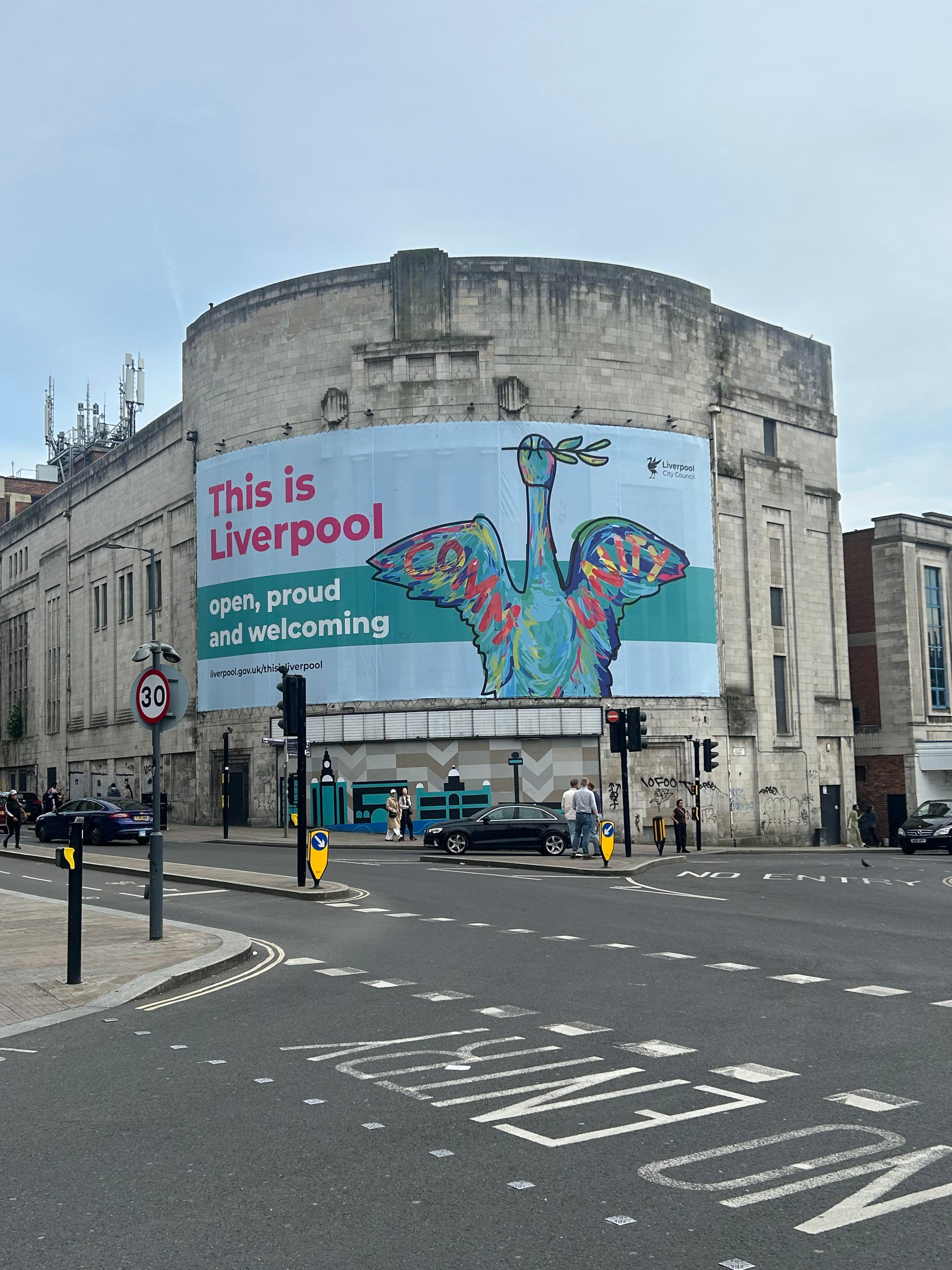
This was one of the first things that I noticed, fresh off the train. And the thing is, Liverpool felt warm. Genuinely. The people were friendly (but a bit different from the London crowd), the pubs were loud in a good way1, and the city had a kind of bruised confidence that I found immediately familiar.
But London, the city I had just come from, the one that doesn’t advertise itself as welcoming, is actually 46% non-white by the 2021 census.2 Liverpool is 16%.3 It felt a bit like a person who introduces themselves as “very chill” at a party. The ones who don’t mention it usually are.
I have seen this before, closer to home.
Kolkata hosted South Asia’s first-ever Pride march.4 July 2nd, 1999. Fifteen people attended that event. In their colourful shirts, walking through the monsoon rain. The city had its history with rights movements, its self-image as the progressive, intellectual capital of India. And that self-image might not be entirely wrong. The adda culture, the Bhadralok, the Bengali Renaissance, Tagore. The city believes in its own openness.
But walk around a tech park in Bangalore or Hyderabad on a busy Monday morning. You would notice the sheer diversity of states, languages, accents, and food in the cafeteria. It is a melting pot of cultures. Then walk around the offices of Kolkata. The signal is drastically different.
This is not about dismissing the cities and their claims. Both cities might be welcoming. But labelling yourself as “welcoming” doesn't always translate into people from different backgrounds actually coming. For that, you need a slightly different gravitational pull. You need investments. You need to cultivate a different culture.
Both Liverpool and Kolkata were, at some point, two of the most commercially important cities in their respective empires. The ones through which the wealth actually moved. Liverpool’s docks in the 19th century were pivotal. Calcutta was British India’s commercial and administrative nerve centre until 1911, when the capital quietly shifted to Delhi.
Then came the decline. And here the stories rhyme so closely it’s almost uncomfortable.
Liverpool’s version had a clear villain with a name. After the Toxteth riots of 1981, Geoffrey Howe, Thatcher’s Chancellor, wrote a private memo suggesting the government consider “managed decline” for Liverpool.5 The suggestion was quite straightforward - don’t spend any money there. Let it go. “We must not expend all our limited resources in trying to make water flow uphill.” The memo became public 30 years later. Liverpool has not forgotten it. Almost 60% of the city voted Remain in 2016. The Conservatives haven’t won a council seat there since 1998. The city’s relationship with Westminster is structurally contentious. If one goes north, the other would prefer south.
Kolkata’s story is messier and more layered because it had multiple villains. The first one came from Delhi, and it wore the costume of fairness, whereas the reality was different. Completely.
In 1952, the Government of India introduced the Freight Equalisation Policy.6 The stated intent was balanced regional development. In practice, it subsidised the transportation of raw materials (coal, iron ore, steel) to anywhere in the country, eliminating the cost advantage of being close to the source. West Bengal, Bihar, and Odisha held over 90% of India’s iron and steel production at the time. The policy stripped them of their natural industrial advantage and redirected private capital towards Maharashtra, Gujarat, Tamil Nadu. Industries moved west and south. The unseen effect of the policy was disastrous for the East. It ran for four decades, until 1993. Pranab Mukherjee, a Bengali, later admitted it as a leading cause of eastern India’s industrial stagnation.7
Howe’s memo explicitly said, “Let Liverpool decline.” The freight policy was implicit in nature: “Let’s build a system where Kolkata’s advantage counts for nothing.” One was outright cynical in nature, whereas the other one wore the suit of an economic idea. The outcome, for both cities, was roughly the same.
Then came the homegrown villains. The Left Front governed West Bengal for 34 consecutive years. The labour militancy, the political violence, the brain drain - it was all happening at once. And then TMC, who continued the tradition of “spectacular governance” with different and worse aesthetics. Until very recently, West Bengal had never been governed by the party at the centre. Delhi and Kolkata have had a cold relationship.
Ask someone from Kolkata why Bengal always fights Delhi, and they'll say: because Delhi has always been wrong. Ask someone in Delhi, and they'll say: because Bengal has always been difficult. Liverpool and Westminster have the same conversation, in different accents.
Both cities interpreted being left behind as proof of their own distinctiveness. Which, to be fair, it partly was.
So what did they do instead?
Liverpool sold the Beatles. Kolkata sold Tagore. Both are, in their own ways, real. The cultural output of both cities, across music, literature, cinema, football, and “intellectual tradition”, is genuine and significant (Liverpool 10x more than Kolkata obviously). I am not being dismissive. But there’s a difference between a city that has culture and a city that has replaced its economy with culture.
The regeneration documents for Liverpool are full of phrases like “knowledge economy” and “creative industries.”8 But the Albert Dock tourism, Beatles pilgrimages, and stadium tours are far from being the hallmarks of a creative industry. Liverpool's own government data shows the city produces 25% less economic output per person than the national average. That gap has not changed in a decade. The regeneration documents use the phrase 'knowledge economy' anyway.
Kolkata has IIT Kharagpur nearby, ISI, Jadavpur University, and some real research output. But compare that to Hyderabad or Bangalore on actual economic footprint, and the contrast becomes clear.
Both cities were, to some extent, forced into this. The industries left. The investment didn't come. But at some point, the story you tell about being left behind stops being an explanation and starts being an excuse. The chip on the shoulder becomes the identity. The grievance becomes the brand.
Liverpool’s stadium tour is excellent. I did it. Walking out of the tunnel, into the ground where Shankly built something from nothing, you feel it. I had goosebumps. But Shankly didn’t build a monument. He built a team, with working-class people who had very little, and told them it meant more. The irony is that “This Means More” is now a premium hospitality package.
Kolkata’s Durga Puja is a genuine marvel of collective creativity, a UNESCO Intangible Cultural Heritage since 2021.9 But the same city watched its manufacturing base hollow out over three decades and responded primarily by getting better at organising the puja.
I should say where I am standing. I am from Kolkata10. I love the city unreasonably (and often I hate this fact), the way you love things that formed you before you had opinions about them. And I spent only ~48 hours in Liverpool. Long enough for a poster & the people to occupy a space in my mind. The warmth was real. The history is real. It is genuine. It attracts thousands - across the universe.
But “Open, Proud & Welcoming” on a poster at Lime Street, and “Cultural Capital of India” on a thousand Kolkata tourism websites - are both doing a specific kind of work. They are cities narrating themselves into relevance.
The ones which are, generally, don’t narrate.
This is the post I promised in The City That Invited Me to Take a Walk -“Liverpool deserved its own”
Read more of my writings here, and learn about me here.
If you found this interesting, I would love to hear your thoughts. Share it on X, or reach out at shibaprasad.b[a]outlook.com.
Observations, data, and the not-so-ordinary world. Subscribe if that's your kind of thing.
They were playing Beatles, Stones, and Rod Stewart, etc! It was awesome!
Well - 3 kms away from Kolkata, actually. But you get it!