

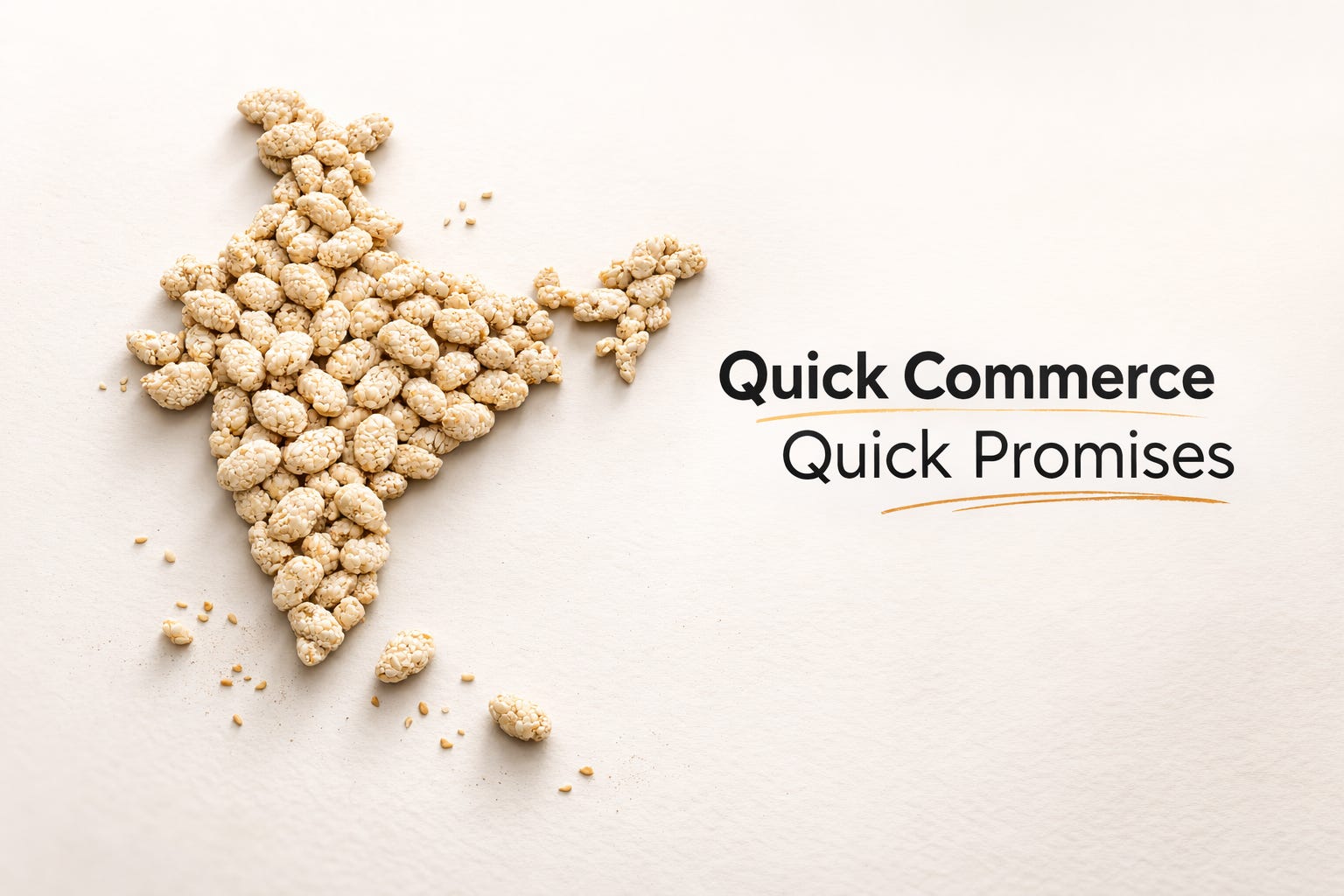
The Karnataka 2023 assembly election was the Zepto moment in Politics. Let me elaborate on what I mean by that.
For the uninitiated, Zepto is a quick commerce company in India. They started their business in 2021 with a radical promise - 10-minute grocery delivery. When they started, India already had some quick commerce players who were relatively slow (~30-45 minutes). Zepto were aggressive with their promises.
At that time, some existing players like Big Basket shrugged them off completely. Big Basket had a model where you would order groceries and they would be delivered the next day. In a selected 4-hour slot. They were adamant that Zepto’s model wouldn’t last. Unscalable, they said. Other companies like Swiggy Instamart, and Blinkit did some retrospection and started adapting slowly.
Fast-forward to 2026, the 10-minute delivery market - though, now, it can’t quite be called that - is thriving. Big Basket still does slot-based deliveries. But they now also deliver iPhones in 10 minutes. They have accepted, quietly, that what they did initially was a mistake of some sort, and had to adapt.
The 2023 Karnataka elections made headlines in a similar fashion. The main opposition at that time - Congress - announced a bucket of schemes which grabbed the headlines. Free bus rides for women in public buses, free electricity up to a certain limit, and more. The incumbent BJP government called it freebies. “Revdi culture,” the PM said - revdi being a traditional North Indian sweet, the phrase was his way of calling these promises empty handouts, distributed for votes the way sweets are distributed at festivals. He doubled down on this framing across multiple campaigns, including in the 2021 Delhi election. The message was consistent: you cannot make systematic progress with these policies.
Congress won the 2023 Karnataka election with a thumping majority.
Then came Delhi’s election in early 2025. At rallies in Rohini and RK Puram, the PM assured voters that not a single existing welfare scheme - the same free electricity, the same free bus rides - would be discontinued if the BJP came to power. The then-ruling CM of Delhi, Arvind Kejriwal, not without some glee, called it an acceptance of their model. The word “revdi” didn’t come up. ¹
Delhi is not a single case. In Maharashtra’s 2024 election, the competitive bidding reached almost comedic levels. The ruling Mahayuti’s Ladki Bahin scheme started at ₹1,500/month for women. The Congress-led MVA countered with ₹3,000. Mahayuti then revised their own promise to ₹2,100. Both alliances were simultaneously promising farm loan waivers, youth stipends, senior citizen pension hikes - each announcement timed within days of the other. ² And within days of actually winning on the back of Ladki Bahin, officials quietly began reviewing whether the state could afford it. ³ In Madhya Pradesh, Bihar, wherever there was an election, similar optics followed.
There are two things worth sitting with here.
One is that welfare schemes are not inherently bad. A large portion of the country is still below the poverty line, and direct cash transfers can be meaningfully helpful. Development economists like Jayati Ghosh argue that basic welfare - free water, food, electricity - isn’t a freebie but a human right, with real downstream gains in productivity and consumption. The government’s own Economic Survey 2024-25 found that welfare schemes are narrowing the urban-rural consumption gap, with the bottom deciles seeing the highest expenditure growth. ⁴ That’s not nothing.
The other thing is the motive. Means & ends. The RBI has flagged repeatedly that states with revenue deficits are spending over 20% of their revenue expenditure on subsidies, crowding out capital investment. The Supreme Court, as recently as February 2026, called it a “culture of freebies” and a threat to fiscal stability. ⁵ There’s a difference between a welfare scheme designed to help people and one designed to be announced before an election. The trouble is that from the outside, they look identical. And everyone - voter, journalist, economist - has largely stopped pretending otherwise.
We are seeing something similar in quick commerce. Swiggy’s Instamart and Blinkit are both burning significant cash - expanding dark stores, subsidising deliveries, fighting for market share in what analysts have called a “land grab” phase. ⁶ Zepto, the category-defining player, hasn’t been publicly listed, so its finances remain opaque - though a confidential IPO filing in late 2025 may change that soon. ⁷
Instead of organising the quick commerce space more efficiently, the players are doubling down on speed. Just as the political parties are doubling down on poll promises, rather than directing spending to where it is more structurally needed.
When will it end? In quick commerce, I think the practices will slowly converge. Most orders already arrive after 10 minutes. It will probably settle somewhere around 20-30 minutes, which is operationally far more sustainable. SKUs will be reduced. A hub-based model may emerge for costlier items - you can get an iPhone in 3 hours, not 20 minutes. The companies have a clear reason to get there. They need to make money for their shareholders, and reality has a way of asserting itself.
That pressure doesn’t exist for politicians. The Karnataka moment showed everyone - across party lines - that welfare schemes win elections. Big Basket saw the demand and adapted. Every political party saw the result and adapted. The difference is that Big Basket’s pivot will eventually have to pencil out. The political pivot has no such requirement.
I don’t see this changing unless the policy conversation succeeds in making it costly - not morally, but practically - to promise schemes without funding plans, without sunset clauses, without any accountability for what happens after the votes are counted.
Or unless voters start asking for different things. More roads. Better schools. Institutions that work. That’s a slower, harder kind of politics. But it’s the only version where the incentive actually changes.
NOTE: I am a product & policy observer. Views are personal and do not reflect those of any organisation that I am a part of.
Ordinary thoughts, shared with hope. Pass it along if it resonated.
Footnotes
¹ Modi at Rohini rally, Jan 5 2025 - Business Standard; BJP wins Delhi - Business Standard, Feb 8 2025
² Maharashtra 2024 election - Wikipedia; Maharashtra party manifestos - Marksmendaily, Nov 2024
³ Mahayuti mulls tweaks to Ladki Bahin scheme - Business Standard, Nov 26 2024
⁴ Economic Survey 2024-25 on welfare schemes - PIB; Freebies vs welfare debate - Outlook India
⁵ RBI State Finances report analysis - Ideas for India; Freebies and Fiscality - Millennium Post, Feb 2026
⁶ Swiggy Instamart losses - Bloomberg, May 2025; Swiggy in 2025 - Inc42