

Before we begin: Ordinary Analysis is my notebook of random-but-reasoned observations. It’s free, always will be, and you can get it in your inbox with a single click - subscribe.
In mathematical programming, there are a few types of variables. Two common types are binary and continuous variables. Think of them as different ways to count or measure things.
A binary variable is simple: it's either 0 or 1. It's like a yes-or-no question. For example, if you're deciding whether to build a new factory, you could use a binary variable: 1 means yes, build it; 0 means no, don't.
A continuous variable, on the other hand, can take on any value within a range. It's not just yes or no, but "how much?" or "to what extent?" For instance, you could use a continuous variable to measure how much steel a factory should produce, from 0 tons to infinity.
I’ve always had a habit of making sense of everyday things through math. For a long time, I used to think of companionships, friendships and relationships, as binary variables. You're either friends with someone or you're not. You're either someone's partner or you're not.
But friendships seem to be a lot more complicated than that.
Let's look at this chart. It shows how close someone's friendship with another person might be, using a continuous coefficient.
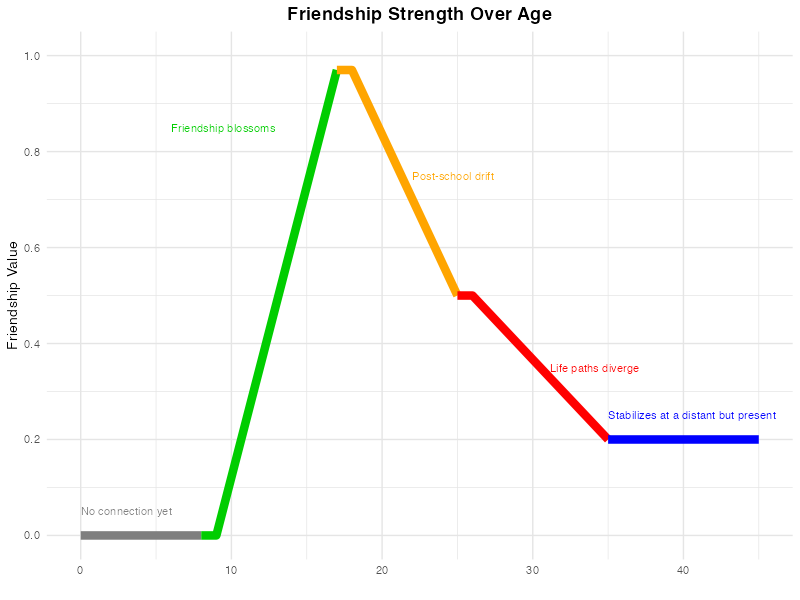
Suppose they were school friends. For the first few years, the value would be 0. Then, during school, they grew closer, becoming good friends (the value might climb to 0.97). But after college, they drifted apart, their lives going in completely different directions.
I used to think that when this happens, the relationship becomes a binary variable again. It drops from 1 to 0. You stop being friends and lose touch. But I've come to believe that for a healthy friendship, if both people want it, it should ideally act like a continuous variable. The value may drop far below 0.97, but it doesn't have to become 0. It can be a connection that's far less intense, but still there.
I haven't always been good at updating my own friendship variables. For many people, I have kept them at 1, assuming we were still close friends. But in reality, it’s probably closer to 0.5. Loosely connected, but still present. And maybe, that’s okay.
When it comes to romantic relationships, I feel they should be treated as binary if things end. The rare exception is if the two people were good friends long before they became romantic partners. Then, maybe you can go back to being friends. But to try and maintain a sense of continuity, even after the demise of romance, doesn’t quite sit right with me.
What do you think? Have you ever thought about your relationships in terms of these mathematical concepts?
Ordinary thoughts, shared with hope. Pass it along if it resonated.