

The evolution of football tactics and tech product innovations shows strikingly similar patterns.
Jonathan Wilson, in his book Inverting the Pyramid, discusses football tactics in great depth. It is something of a unified theory of football history from a tactical perspective. If you step back and analyse the patterns, it becomes clear how they evolved. His core thesis was roughly this: every dominant idea creates a weakness that the next idea exploits.
The short historical evolution goes like this:
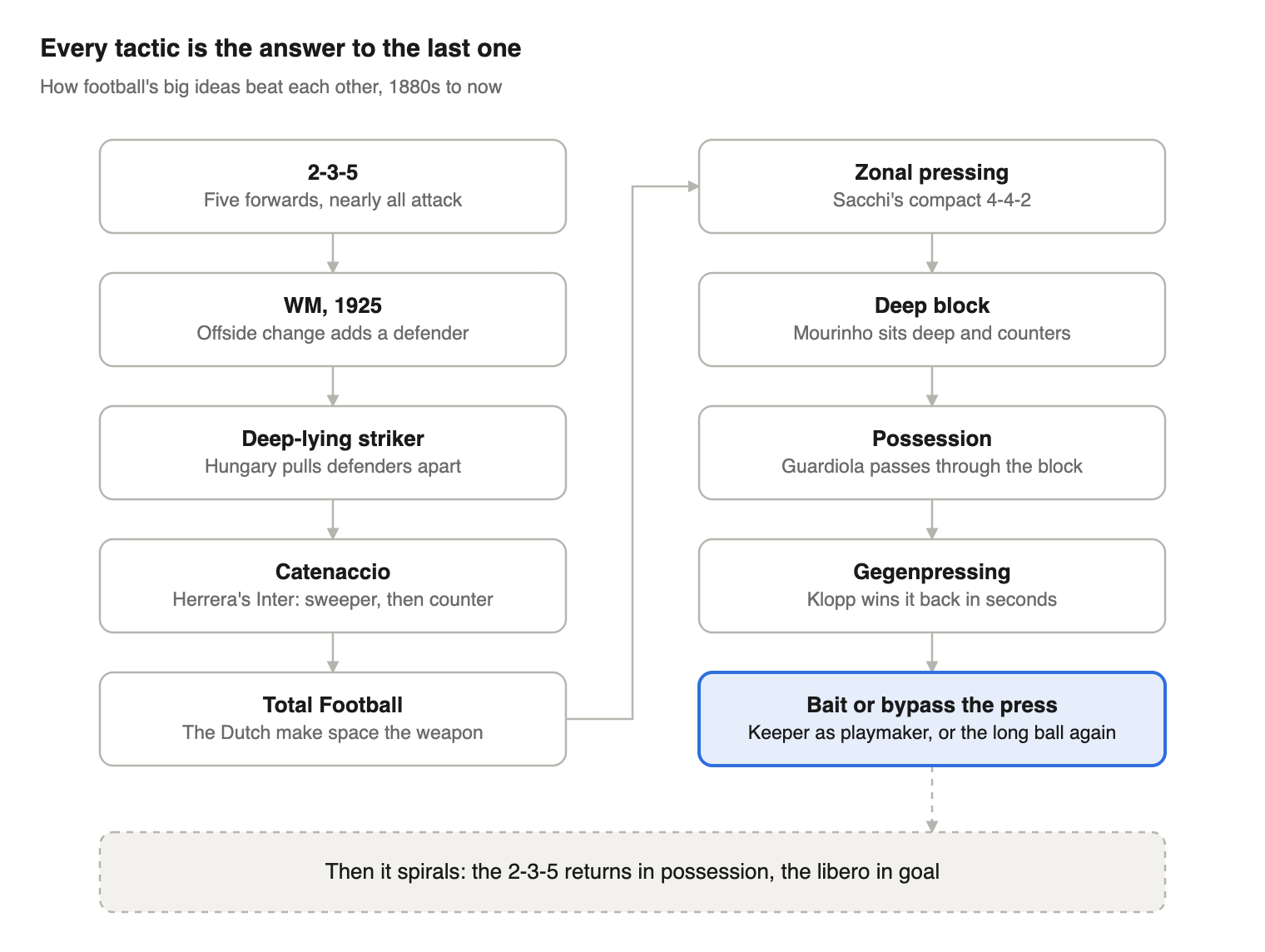
In the late 1800s, the game lined up in a 2-3-5 formation with 5 attackers. When there was a change in the offside law, Herbert Chapman pulled a man back, and the WM formation was born. When Hungary’s deep-lying centre-forwards started dragging defenders out of shape, Helenio Herrera’s Inter came up with an answer: Catenaccio. A sweeper behind man-markers. It was designed to defend deep and hit you on the counter. It worked very well and was hated.
The Dutch then invented “Total Football”. Here space mattered more than individual players. And everyone played everywhere. Sacchi’s Milan then modified that, introducing a compact zonal press with a 4-4-2 formation. Through the 90s and 2000s, Cruyff’s Barcelona kept the Dutch passing idea alive, while Mourinho perfected the deep, compact counter-attacking block (some elements of Catenaccio made a comeback - in a new form).
Guardiola, Cruyff’s pupil, beat those blocks with possession. Klopp used gegenpressing to beat possession. Now teams beat the press by baiting it (the goalkeeper often becomes the first playmaker) or going straight over it.
If you watch Pep’s Manchester City or Arteta’s Arsenal build an attack, you’ll often notice five players strung across the front line. Teams also often maintain different shapes while attacking and defending. The sweeper-keeper is catenaccio’s libero, but now wears gloves. Man-marking was declared obsolete by a generation of zonal coaches. But it is fashionable again thanks to Bielsa & Gasperini.
It is not a circle. But more like a spiral. You get the gist.
Now, coming to tech products.
Uber started as a company offering private cabs. It aimed to reduce the hassle so that one doesn’t have to go near a bus stop or a cab stand. Then came Pool, where a few strangers share the ride. Anyone who has squeezed into a shared auto knows exactly what that is. Then came the shuttle, which is a bus.
Take dating apps, for example. The core idea of those apps was to connect people 1:1. Remove the friends, family, aunties from the picture. You liked someone? Connect directly. But many dating apps have started to spring up, services like community hangouts. Now Rivet, started by a former Tinder executive, has even gone a step further. Here, a community (strangers, elite matchmakers) votes for a suitable mate based on different preferences.
Airbnb is another good example. It started with the idea of staying at someone’s home and paying for it. Now, you have hotels, managers, and everyone listed there. Or consider Netflix. It ‘disrupted’ the whole TV-watching experience, but now it has ad-supported plans, live events, and even a production studio!
Jim Barksdale (the former Netscape CEO) has a line for this: there are only two ways to make money in business, bundling and unbundling. Tech unbundles to get in (one cab, one person, one swipe). Then the economics kick in and it rebundles (shared rides, shared buses, shared hotels).
I find Clayton Christensen’s “Jobs to Be Done” framework quite profound here. People don’t want a cab. But they want to go from point A to point B (if they are like me - then ideally without small talk). They are not looking for a dating app but a decent partner. The ask barely changes. And when you have tight economics forcing a compromise, we have only a few ways to do this. It is quite constrained.
What’s new?
This is also important. Uber shuttle isn’t exactly a bus in the traditional sense. You get a guaranteed seat. And the routes are determined based on demand. Rivet isn’t just an aunty either. It has the wisdom of the crowd, which should (ideally) eliminate the aunty's poor judgment. It is the same way the modern 2-3-5 isn’t the old Victorian football anymore.
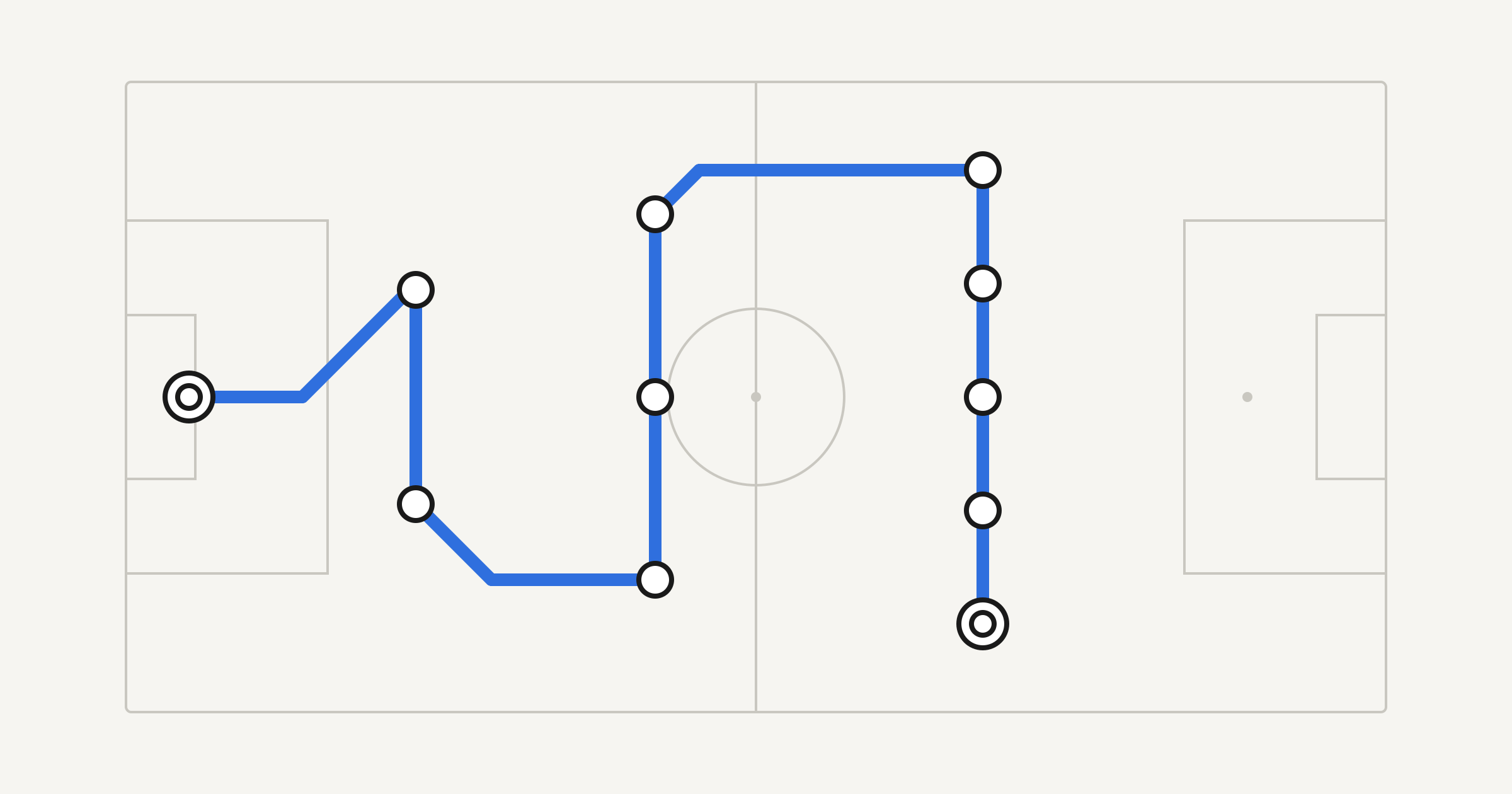
The big difference is fluidity. Herrera invented catenaccio and lived and died by it. A modern team can be a 4-3-3 without the ball, a 3-2-5 with it. Pressing in the opponent’s half, but not in one’s own. The formations used to be identities. Now they’re not.
Uber works the same way now. One app, and you pick a cab, a pool or a shuttle depending on how late you are and how much you care. These options have existed for a long time, but the feature to switch between them is new.
This is probably the bigger pattern, in football and in tech. Old ideas rarely disappear. They stop being the whole idea and become building blocks for the next one.
A bus becomes a shuttle. An aunty becomes an algorithm-assisted community.
Observations, data, and the not-so-ordinary world. Subscribe if that's your kind of thing.
If you found this interesting, I would love to hear your thoughts.