

In the Facebook era, there used to be a relationship type which often would flood groups with discussions: ‘complicated’. The relationship we have with our devices is like that; the only difference is we don’t see many discussions going on around this.
After the COVID outbreak, if there is one thing that has quietly disrupted many lives, it is reels. From the cab driver to the software engineer, from the security guard to the grandpa in the park, I have seen people completely engrossed in them, barely noticing what is happening outside.
Luckily, I have never found them very appealing. Unfortunately, that did not mean my relationship with my devices was particularly healthy. It was still complicated. My problem was somewhere else.
The Trigger
When it came to reading books, I was having a hard time finding time. And when I managed to make some time, I found it hard to focus on reading. I was not reading enough.1 This had been sitting uncomfortably at the back of my mind, and I wanted to make some changes. It didn’t take long to trace it back to one source.
My big issue was WhatsApp.
I intuitively knew I was spending way more time on WhatsApp. But I never really tracked how much time I was spending there. I looked at my data in Apple’s Screen Time, where you can track the screen time for the last two weeks. And holy shit! Around February, when I checked for the first time, my WhatsApp usage was through the roof. For the last two weeks, the average daily use was almost 5 hours, combining both mobile and laptop.
And just to make it more clear, I have had WhatsApp notifications disabled for 7-8 years. So, one can understand the depth of the problem I was having.
I had to do something.
The Intervention
I started with a few strict approaches.
First, I deleted WhatsApp from the laptop. There was now no way to access it from there.
Second, I started doing batch checking. Previously, I would check it whenever I felt like. And the dopamine hit would make me come back to it. But I changed my behaviour massively. I decided to check it in batches: morning, post-lunch, evening and night. (It hasn’t been perfect; you will see that soon.)
Third, I stopped opening the groups on most days, especially the larger ones where we do most of our adda (chit-chat).
Alongside these three, I started checking the screen time numbers 3-4 times a day. There was this Dutch experiment where just showing people how much electricity they were consuming helped reduce the bill. It’s the same feedback-loop logic that Fitbits or any smartwatches run on. If you constantly see how little you have walked, then it will nudge you to walk more.
This worked like that for me. It helped me steer in the right direction.
I also deleted all the news-related apps I had on my phone, and went back to RSS. Rather than depending on their constant push notifications, I went to a pull medium. I started intentionally looking for news only when I wanted.
Last but not least, I muted all notifications. From 10 AM to 7:30 PM. Except text messages.
The Result
First: the WhatsApp usage. I have been dumping the data into Claude/ChatGPT every Sunday morning and maintaining an Excel sheet. Apple shows total weekly data - from there we can derive average per-day numbers for each week.
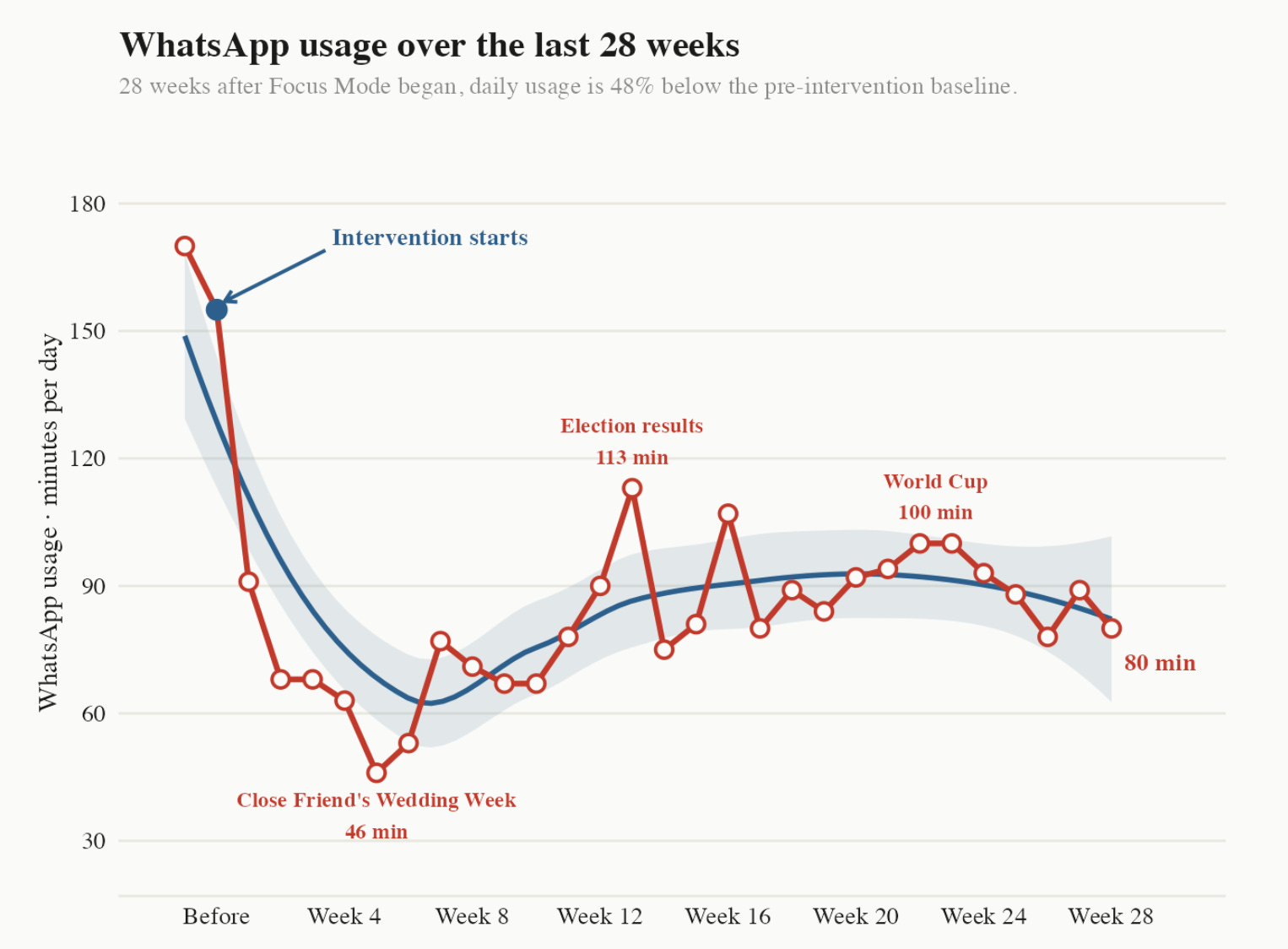
The intervention worked. WhatsApp usage fell from 155 to 80 minutes a day, a 48% reduction. The decline was uneven, with temporary spikes around elections, travel and the World Cup, but the longer-term trend remained downward.
Still, I am far away from hitting the desired numbers. I would like to keep WhatsApp consistently under 80 mins, and total phone usage under 3-3.5 hrs.
My total Social Media & phone usage also went down significantly. Of the 153 daily minutes I stopped spending on my phone, 97 came from social media alone. Which is almost 63%!
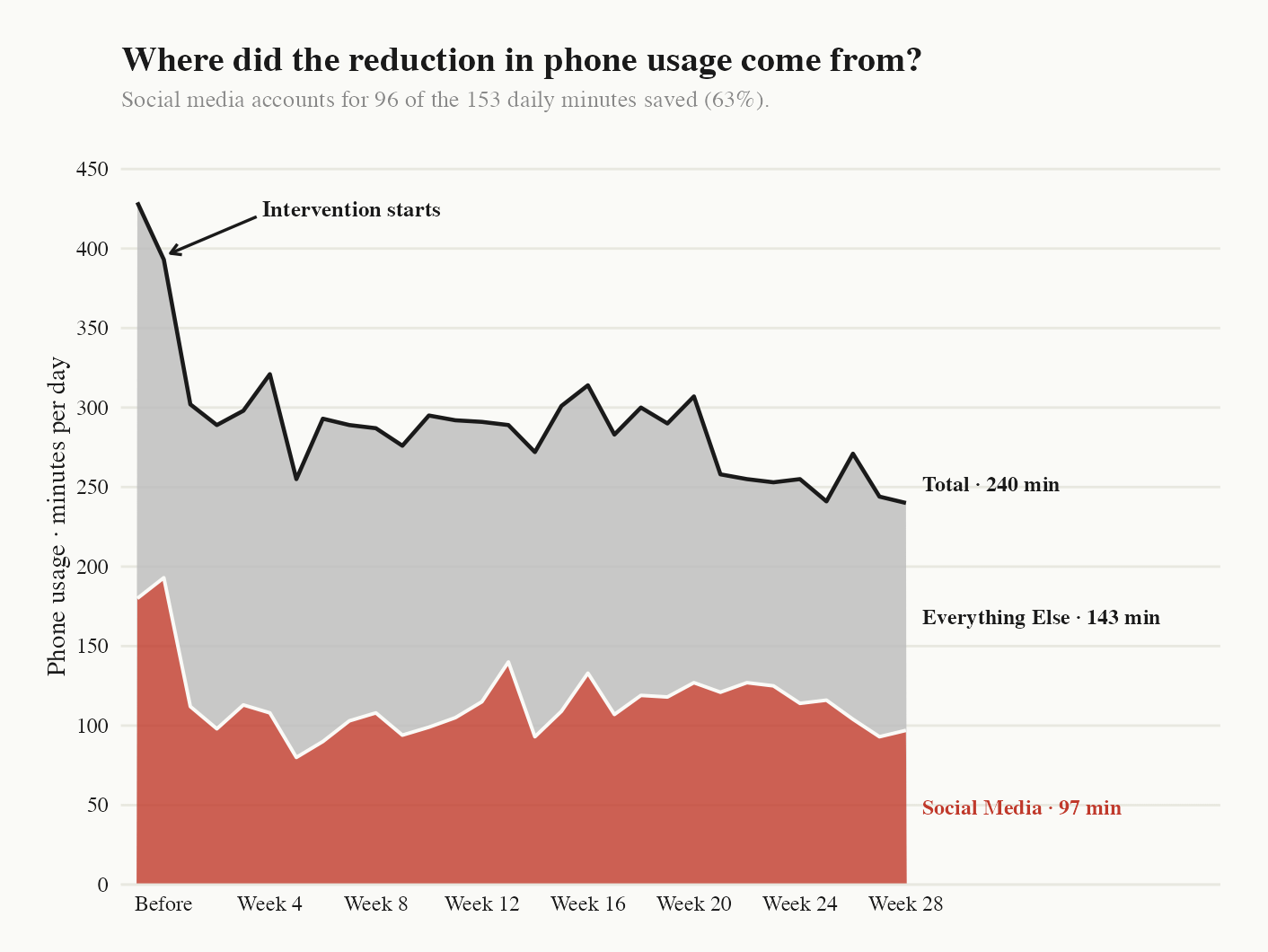
(One thing to mention here: these numbers include, on average, 15-20 mins of video calls with Ma daily.)
My Insta numbers, on the other hand, are quite healthy and insignificant compared to WhatsApp. The peak was 22 mins.
The bigger shift was where that saved time went.
My reading capacity has increased compared to the earlier base level. I had set a target of reading 7 books this year (last year it was 5), and I am already done with ~6 books.2 If everything goes well, I might finish more books.
But the number of books was probably not the most interesting part.
There were 2-3 weeks when I found it very hard to let go of reading a book. It was The Kite Runner, a fiction book and less dense than the ones I usually read, but still that feeling was quite different. One that I hadn’t had in years.
It didn’t stop with reading. I have also managed to build a structured routine for writing, which has helped me massively in writing here and on my personal and more technical site.
And I have resumed long-distance running again. More updates on this later.
The Realisation
The first realisation was: why WhatsApp over Instagram? Insta/TikTok-type content has been almost universally deemed more harmful for our engagement and attention span.
Reels keep you hooked on the premise that you don’t know what you are getting next. Most of it is boring (at least that’s what I feel), but then you get one or two interesting ones, and you keep swiping. WhatsApp pulls you back, mostly, for different reasons. There are people on the other side who are making conversations, and you know them. Well, most of them.
I realised I am much more interested in the people I know. I want to talk to them, do casual chit-chat whenever possible. Many of them I have known for 10+ years through different social media networks. So these groups made me come back to WhatsApp.
Instagram, for me, didn’t have that pull at all. It mostly offered strangers; WhatsApp offered people I actually cared about. Often I would like some completely random, unhinged reels. But I don’t really care about some random dude from Missouri making reels. I was going through my feed before writing this; 17/20 posts were from accounts I don’t follow.
Give me a break.
The friends I have on that platform don’t post much either. So I don’t necessarily have anything genuine to look forward to there.
That was probably why the usual explanation of “social media addiction” didn’t quite describe my problem. WhatsApp was kind of like a proxy for the real engagement I was missing with my friends and acquaintances.
But here is the thing: when social media networks weren’t there, we hardly met our friends every day. It was occasionally planned. Once a week while playing football. Once a week after returning from the office. Doing these periodic activities every day would erase their significance.
But as we are now scattered over the globe, it is sadly the best we can do.
I also realised that these restrictions work much better when there is something waiting on the other side. During my notice period, or while travelling, I found it much harder to stay away from that digital brick. Cal Newport has made this point repeatedly: subtracting low-value digital activity works poorly if you do not replace it with something better.
The Relapses
This wasn’t completely a journey without setbacks. And I didn’t expect that to happen either. As it is evident from the plots.
I have had many failures over the last 27/28 weeks. The election results, the FIFA World Cup, etc. But the important thing was not to obsess over the relapses, and come back to using it the next day.
Not The End
Another important realisation that came from the whole exercise is that this is more effective if it is a means to an end, rather than the end itself.
For example, if you want to reduce weight, or be fitter, starting to exercise is a good way to do so. But it is not enough. You have to do other things too: diet, sleep, etc.
Similarly, only doing this, but not performing the duties that you have, would be of little use. Though I would argue that it won’t be completely useless. Like even with subpar diets, exercising has benefits. Similarly, staying away from social media and not making a billionaire of San Francisco richer has substantial benefits for you.
It is just not the whole package.
It would be more useful if these interventions helped us become more present in our own lives. To read, write, run, work, meet people, or simply pay attention to whatever is in front of us.
My relationship with my devices is still complicated. I am not there yet completely.
But at least now I know what the complication is.
Observations, data, and the not-so-ordinary world. Subscribe if that's your kind of thing.
Read more of my writings here, and learn about me here. I also write essays on tech, product, and strategy over here.
If you found this interesting, I would love to hear your thoughts.
Ideally, I would like to read one book every week. But well….
I am aware that treating this as a target is not healthy. The real target is increasing cognitive capacity.